Presbyterians have a large gene labelled Modesty running around in our spiritual DNA.
Most of our parents taught most of us to 1. stay nice and quiet during the worship of God, and 2. never to brag. Makes sense. You can add to these parental prohibitions a strong emphasis in our Reformed tradition on glory always being given to God and not to humanity. Even faith itself is a gift, we say. Boasting is the cardinal Presbyterian sin.
Given all of this, the invitation to talk about ourselves in the context of faith and church likely leaves many of us feeling a bit uneasy. Even more, the language of "spiritual gifts" might sound to some like it better belongs in one of those other Christian churches, perhaps one on a cable access channel. Bottom line: Is the naming aloud of our spiritual gifts — be they communal or individual — a form of bragging? Is it, inevitabily: "I have the spiritual gift of wisdom ... Look at me!"
The New Testament is chockablock full of language about the gifts Christ gives to his church, in every generation and in every place. Ephesians 4 is my favorite example, where the apostle lists a sacred chain of invisible gifts that are given by the Spirit for building up the visible church. The logic of Paul's gift-talk seems to run like this: God gives good gifts to those God calls to faith, gifts for blessing the whole of the faithful, all so that the faithful can become the kind of persons whose lives and love bring glory back to God amid a watching and wanting world.
It is this logic that hedges against bragging. Our gifts come from God, not us. No one can claim original ownership. And when gifts bear fruit in the church and in the world, the taste of said fruit will develop an appetite in others for the divine, not for us. Glory (emphasis, reputation, legacy, credit) goes back to God, not to us. In short, spiritual gifts are gifts to be given away. There is no room in that chain of logic for self-referential bragging. But given the mandate to use them for blessing, there is also no need to keep the whole matter under wraps. Indeed, there is a real sense in which we need each other to help each other discern what our own gifts might be. That calls for conversation, and prayer, and encouragement.
There is freedom in the grace of gifts, freedom to ask of our lives and of a congregation's culture: What particular invisible gifts has God entrusted to me and to my visible community? All disciples and all communions share Jesus in common, as well as his faith, hope, and love. But beyond those sacred universals, what are the particular marks of God's gifting grace in our history? Asking these questions, sharing in this discovery, and celebrating our findings — this activity is not bragging; this is stewardship. To whom much is given (by God), much is expected (by God). Staying clear about what has been given TO us helps us stay alert to those moments when grace invites us to give AWAY the spiritual blessings Christ has deposited in our communion.
What gifts of a spiritual nature has the Holy Spirit invested in your life?

Showing posts with label ministry. Show all posts
Showing posts with label ministry. Show all posts
January 30, 2019
October 25, 2018
Four Dimensions
"My God, my Father and my Savior, since it has pleased thee to preserve me by thy grace through the night just ended and until the present day, grant that I may use it entirely in thy service and that I may, say, and do nothing but to please thee and to obey thy holy will, so that all my actions may redound to the glory of thy name and the edification of my neighbors."
Sunday is Reformation Day among us Protestants, an annual date intended for the celebration of our heritage as spiritual children of the 16th century Christian reformation in Europe. The quotation above, a sentence from a prayer by reformer John Calvin -- arguably the father of what would later become our Presbyterian way of being church -- is not only a nod to our Reformation roots but also a lovely prayer for the middle week of our stewardship season.
All of life, every sleeping and waking breath, is fundamentally a generous gift from a magnanimous God. That perspective is the only proper starting point for considering our role as stewards of God's good gifts. So the question before us this week is not merely "What am I giving to the church?" Calvin taught us, instead, to ask always: "What have I been given by God? What has God entrusted to me in this life? What time, talent, and treasure is Jesus calling me to share as a pointer for others to God's love and light?"
Sunday morning in worship we return again to the witness of Ephesians 3:14-21, this time with a close look at verses 18-19: Paul's prayer for us that we "may have the power to comprehend, with all the saints, what is the breadth and length and height and depth, and to know the love of Christ that surpasses knowledge, so that you may be filled with all the fullness of God." Paul celebrates the four dimensions of God's generosity in our lives, a grace that spills over in every direction.
How WIDE are we being called to make our Northminster fellowship? To what LENGTHS will we go to share and model the good news that God is love? How can we continue to HEIGHTEN our worship, that it would always be a showcase for God's story? In a world marked by tight and trite soundbites, how can we plumb the DEPTHS of the gospel in ways that inspire and equip others to walk in his way? I myself am confident that if we attend to these sacred quesions, and are open to being ourselves a part of God's answers, the money we need to be the church naturally follow. This is how, in Calvin's words, all our actions "redound to the glory of thy name and the edification of my neighbors."
Let us together grasp all the dimensions of the gospel at work in our lives.
Sunday is Reformation Day among us Protestants, an annual date intended for the celebration of our heritage as spiritual children of the 16th century Christian reformation in Europe. The quotation above, a sentence from a prayer by reformer John Calvin -- arguably the father of what would later become our Presbyterian way of being church -- is not only a nod to our Reformation roots but also a lovely prayer for the middle week of our stewardship season.
All of life, every sleeping and waking breath, is fundamentally a generous gift from a magnanimous God. That perspective is the only proper starting point for considering our role as stewards of God's good gifts. So the question before us this week is not merely "What am I giving to the church?" Calvin taught us, instead, to ask always: "What have I been given by God? What has God entrusted to me in this life? What time, talent, and treasure is Jesus calling me to share as a pointer for others to God's love and light?"
Sunday morning in worship we return again to the witness of Ephesians 3:14-21, this time with a close look at verses 18-19: Paul's prayer for us that we "may have the power to comprehend, with all the saints, what is the breadth and length and height and depth, and to know the love of Christ that surpasses knowledge, so that you may be filled with all the fullness of God." Paul celebrates the four dimensions of God's generosity in our lives, a grace that spills over in every direction.
How WIDE are we being called to make our Northminster fellowship? To what LENGTHS will we go to share and model the good news that God is love? How can we continue to HEIGHTEN our worship, that it would always be a showcase for God's story? In a world marked by tight and trite soundbites, how can we plumb the DEPTHS of the gospel in ways that inspire and equip others to walk in his way? I myself am confident that if we attend to these sacred quesions, and are open to being ourselves a part of God's answers, the money we need to be the church naturally follow. This is how, in Calvin's words, all our actions "redound to the glory of thy name and the edification of my neighbors."
Let us together grasp all the dimensions of the gospel at work in our lives.

October 1, 2018
We Are They
When my pastoral ministry was presbytery leadership, I would often say to our congregations, "Remember that the presbytery is we; we are the presbytery."
My point was that the "presbytery," when functioning as a wider expression of the church, was not some bureaucratic entity over and apart from our congregations, some ecclesiastical monkey on our backs or some Big Brother only checking our minutes. The presbytery is we: our pastors, our sister congregations and their elders -- our common life in Jesus our Christ.
It is true that the "congregation is the basic form of the church." Like politics, all Christian ministry is local. You cannot finally institutionalize or nationalize the body of Jesus; it lives and moves through relationships. And yet a localized congregation by itself is not a sufficient expression of the Christian movement. Churches need each other just like we need each other. Sibling congregations need their siblings to share, encourage, and correct.
We see this lived out in the pages of our New Testament: The church in Corinth is not the church in Philippi, or vice versa. They each need different interpretations of the one gospel message, which is why your Bible contains all these peculiar letters to churches with funny first century place names. Yet they also need each other, learn from one another, and together with all the churches form a multifaceted expression of the community of Jesus. At our best, it is not dissimilar to what we Presbyterians are up to in a presbytery. Two truths are true: Northminster is the basic form of Jesus' church. And Northminster needs our siblings. And they need us.
This month, we have the opportunity to practice the wider Christian expression we call presbytery. On Sunday, October 14, we will abbreviate our Sunday morning worship so as to reconvene at 4pm for a Service of Installation led by our Flint River Presbytery. Three elders and three preachers from sister congregations will lead us in worship and officially "install" me as your pastor. It is a marriage ceremony, of sorts. Vows will be taken, promises will be made, and prayers will be offered for a faithful and fruitful season of ministry -- together. As I am now a member of Flint River Presbytery, there is a real sense in which my (new) spiritual fellowship is coming to meet with your (longstanding) spiritual fellowship, and together we are a better expression of Jesus' body.
We are particularly honored in this 4pm service to welcome as our preacher the Rev. Cindy Kohlmann, currently the Co-moderator of our national Presbyterian General Assembly. Cindy, Deb Tregaskis Bibler (our terrific executive here in Flint River), and I all became good friends in recent years through a national learning cohort of presbytery executives. This summer, Cindy was elected co-moderator of our General Assembly and well spend the next two years traveling around the denomination representing the best of what we hold in common with everyone in the Presbyterian Church (USA). Cindy is as terrific a friend as she is a preacher, so I know we will be blessed by her presence with us.
I hope you'll make time the afternoon of October 14 to continue our Lord's Day worship later in the day and to welcome our presbytery into our worship space. They are we. We -- blessedly -- are they.
My point was that the "presbytery," when functioning as a wider expression of the church, was not some bureaucratic entity over and apart from our congregations, some ecclesiastical monkey on our backs or some Big Brother only checking our minutes. The presbytery is we: our pastors, our sister congregations and their elders -- our common life in Jesus our Christ.
It is true that the "congregation is the basic form of the church." Like politics, all Christian ministry is local. You cannot finally institutionalize or nationalize the body of Jesus; it lives and moves through relationships. And yet a localized congregation by itself is not a sufficient expression of the Christian movement. Churches need each other just like we need each other. Sibling congregations need their siblings to share, encourage, and correct.
We see this lived out in the pages of our New Testament: The church in Corinth is not the church in Philippi, or vice versa. They each need different interpretations of the one gospel message, which is why your Bible contains all these peculiar letters to churches with funny first century place names. Yet they also need each other, learn from one another, and together with all the churches form a multifaceted expression of the community of Jesus. At our best, it is not dissimilar to what we Presbyterians are up to in a presbytery. Two truths are true: Northminster is the basic form of Jesus' church. And Northminster needs our siblings. And they need us.
This month, we have the opportunity to practice the wider Christian expression we call presbytery. On Sunday, October 14, we will abbreviate our Sunday morning worship so as to reconvene at 4pm for a Service of Installation led by our Flint River Presbytery. Three elders and three preachers from sister congregations will lead us in worship and officially "install" me as your pastor. It is a marriage ceremony, of sorts. Vows will be taken, promises will be made, and prayers will be offered for a faithful and fruitful season of ministry -- together. As I am now a member of Flint River Presbytery, there is a real sense in which my (new) spiritual fellowship is coming to meet with your (longstanding) spiritual fellowship, and together we are a better expression of Jesus' body.
We are particularly honored in this 4pm service to welcome as our preacher the Rev. Cindy Kohlmann, currently the Co-moderator of our national Presbyterian General Assembly. Cindy, Deb Tregaskis Bibler (our terrific executive here in Flint River), and I all became good friends in recent years through a national learning cohort of presbytery executives. This summer, Cindy was elected co-moderator of our General Assembly and well spend the next two years traveling around the denomination representing the best of what we hold in common with everyone in the Presbyterian Church (USA). Cindy is as terrific a friend as she is a preacher, so I know we will be blessed by her presence with us.
I hope you'll make time the afternoon of October 14 to continue our Lord's Day worship later in the day and to welcome our presbytery into our worship space. They are we. We -- blessedly -- are they.
September 30, 2015
Sessions
Nearly everyone in this room tonight is a member of a session, because nearly everyone here is a Ruling or Teaching Elder. “Session” is our Presbyterian term for the wise council of a congregation, the regular gathering of those Jesus calls to lead and teach and serve his people, so that they learn to walk in his way and to see that way in our lives. So I challenge you, whichever your part, Ruling or Teaching, play it well, for God’s glory and for the building up of his people. If your place at the session table is only an afterthought in your busy life, an unwelcome burden to be endured until the time your term expires, then let us not be surprised when, following our lead, Jesus’ own people see his spiritual body in much the same way. Instead, let each session be a church within a church: a gathering of Jesus’ disciples who commit to practice the very habits we all say we want to see in the lives of those we hope to see in church. Let us pray for one another, and pray with one another; let us read and reflect, deeply, on the witness of scripture; let us comfort one another in times of church challenge; more important still, let us challenge one another in times of church comfort. Ruling Elders, don’t just telegraph the complaints and anxieties you hear in the parking lot. Listen to your peers, of course, but always remember that we have ordained you to seek the mind of Jesus for his church. Work with your fellow elders, not only to lead the people, but to the BE the people, the people of God. You set the tone. You have the influence, as much in the parking lot as in any pulpit. Teaching Elders, provide for the session of which you are both member and moderator. Lead them in, and submit yourself to, the kind of community we all say we want to see in our congregations. Remember that if we only manage a church’s business, we may not have time left over for the business of making disciples. But when you make disciples of Jesus, you always get the church. Let session be the church, that the church might follow suit. May it be so, because Jesus has said it will be so.
April 3, 2015
#neighborhood: uncomplicated
“The Word became flesh and blood, and moved into the neighborhood.” (John 1:14, The Message)
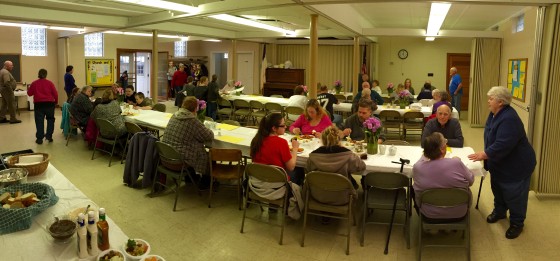
Sometimes we overthink church.
Take the word "ministry," for example. If you're getting your hair done downtown and the gal next to you says something like, "You know, so-and-so's son is going into the ministry" ... you'd never think to yourself, "Ah, he's getting ready to shovel his elderly neighbor's walk." Truth is, we've ruined a perfectly good formula (and the word) by making it more complicated than it needs to be. Ministry = Jesus' call + genuine need + our offering of time, talent, or treasure. 90% of the time, that's it. Forget going to seminary. And forget about paying someone in a robe to do ministry for you. Just look around the neighborhood. Don't overthink it.
Do like the Presbyterians in Enon Valley do. Once a month, they invite the whole village downstairs into their square social hall. No overthinking going on here: just a plate full of spaghetti and meatballs (for example), and 119 (this night) of their friends and neighbors. Churched folks, yes. They come. But also unchurched folks. Lots of folks. The mayor was here. A mechanic and his parents. A teenager comes in for a bite before rushing off to opening night in the school play. An Amishman. Kids running around. This is not a soup line. This feels more like someone's dining room. Pass the butter and tell me what your grandkids are doing these days. What a blessing: an uncomplicated meal amid such complicated days.

All this started six years ago, when unemployment in their end of the county kicked into high gear. Folks were hurting, worried. Enon church decided a meal a week would be the right kind of blessing in that kind of time. It was. Remember: Jesus' call + genuine need + our offering. Time went on, however, and some jobs came back around. That's good. It was acknowledged that something weekly was not needed anymore. That's good, too, in its own way. Yet by then, folks had discovered that the gathering would surely be missed if it went away altogether. So they've carried on. 100 folks a month can't be wrong. One year, thanks to donations from the Presbys who help out, the total cost to the church budget to serve more than a thousand folks was a remarkable $2. How's that for a ministry formula?
Jesus' call + your community + meatballs ... or whatever you think will be a blessing.
What ministry is the Holy Spirit nudging you to share in your #neighborhood? Don't overthink it.
#neighborhood: people
"The Word became flesh and blood, and moved into the neighborhood.” (John 1:14, The Message)

I believe it was that nice man Bob, way back in the side burn days of 1971, on that new Street show for teaching children how to be nice, who first asked, “Who are the people in your neighborhood?”
(I bet you are humming the tune in your head now.)
As it turns out, that query was first raised on another street, in an interchange recalled in Luke chapter 10. Hoping to stump Jesus publicly and make himself out to look more religious, a lawyer responds to some of his teaching about the great commandments by playing dumb and asking: Well, who really is my neighbor? (As is sometimes the case in religious exchanges, he didn’t really want an answer.)
No one is playing dumb at First Church, New Castle, however—not about the people in their neighborhood. Twice a month on a Saturday, all throughout the year, some First folks get organized to ask the question again. The doors are opened to the Social Hall. Tables are set. Ovens are warmed. And neighbors trickle in from all around Jefferson Street. They call it Glory Grille. Indeed, some of you may have served. A great many groups have pitched in over the course of 10 glorious years. At this point, First must be inching their way toward 250 meals served since that first table setting.
But the core of this crew will tell you that it is not so much about how many meals are made or seconds served. Sure, the numbers matter. We measure what we value. But ask them — the First folk who come both Saturdays a month, who feel the biggest burden to carry it on — and they’ll tell you how it is more about the people than the food. Greeting. Meeting. Talking. Praying. “Everyone should be met with a smile,” a long-time Glory girl tells me. “This should be a place that brightens their day.” Maybe that explains the back of her shirt: “His light in the city.” The gold on blue letters are a reminder to us all: Let the glory of our grilles, the glory of our guests, shine on the one who hosts us all in the first place. Matthew 22:1-10
Folks at First learn twice a month who is really in their neighborhood. Once a sanctuary full of Suits and Hats, these days some at First wrestle with how the Holy Spirit is nudging them toward the neighbors who are actually along their stretch of Jefferson. That’s a tune all of our churches could be humming, whatever our streets are called.
Who are the people in your church’s #neighborhood?
March 13, 2015
#neighborhood: songs
"The Word became flesh and blood, and moved into the neighborhood.” (John 1:14, The Message)
 Once a month, throughout the year, the deacons of Wampum Presbyterian Church visit a nursing home in the region. Call it a traveling tabernacle of smiles and songs, whose liturgical paraphernalia is simple. A box of songbooks is lugged in from one of their cars. Deacon types, after a Tuesday’s worth of work, gather in a stuffy rec room with broad smiles on their faces. Residents of the home are soon wheeled in like royalty. Greetings are offered in the name of Jesus. And then songs are sung — and not those new-fangled songs, either. The good ones. “In the Garden.” “Amazing Grace.” “Jesus Loves Me.” They sing, and sing, and sing some more. For some in the room, Anna Warner’s familiar words seem to be the only time they move their lips. Others just hum along, eyes closed. Later, a deacon rises to offer a tender reflection on March’s St. Patrick’s day, putting a nice gospel twist on the proverbial rainbow and its pot of gold: “God gives us rainbows,” she says, "to remind us of his promises.”
Although there may not be a pot of gold at the end of this evening, the burdens of advanced age — loneliness, isolation, loss of faculty — have surely been lessened just a bit for all concerned. And that is something. What’s more, they’ll be back, these Wandering Wampums. If not next month, soon enough. Songbooks and all.
How are you moving into the #neighborhood?
Although there may not be a pot of gold at the end of this evening, the burdens of advanced age — loneliness, isolation, loss of faculty — have surely been lessened just a bit for all concerned. And that is something. What’s more, they’ll be back, these Wandering Wampums. If not next month, soon enough. Songbooks and all.
How are you moving into the #neighborhood?
Subscribe to:
Posts (Atom)